Live at licitapr.com
LicitaPR Inteligencia
Six government systems that don't talk to each other, unified into one procurement-intelligence product that looks ahead instead of back.
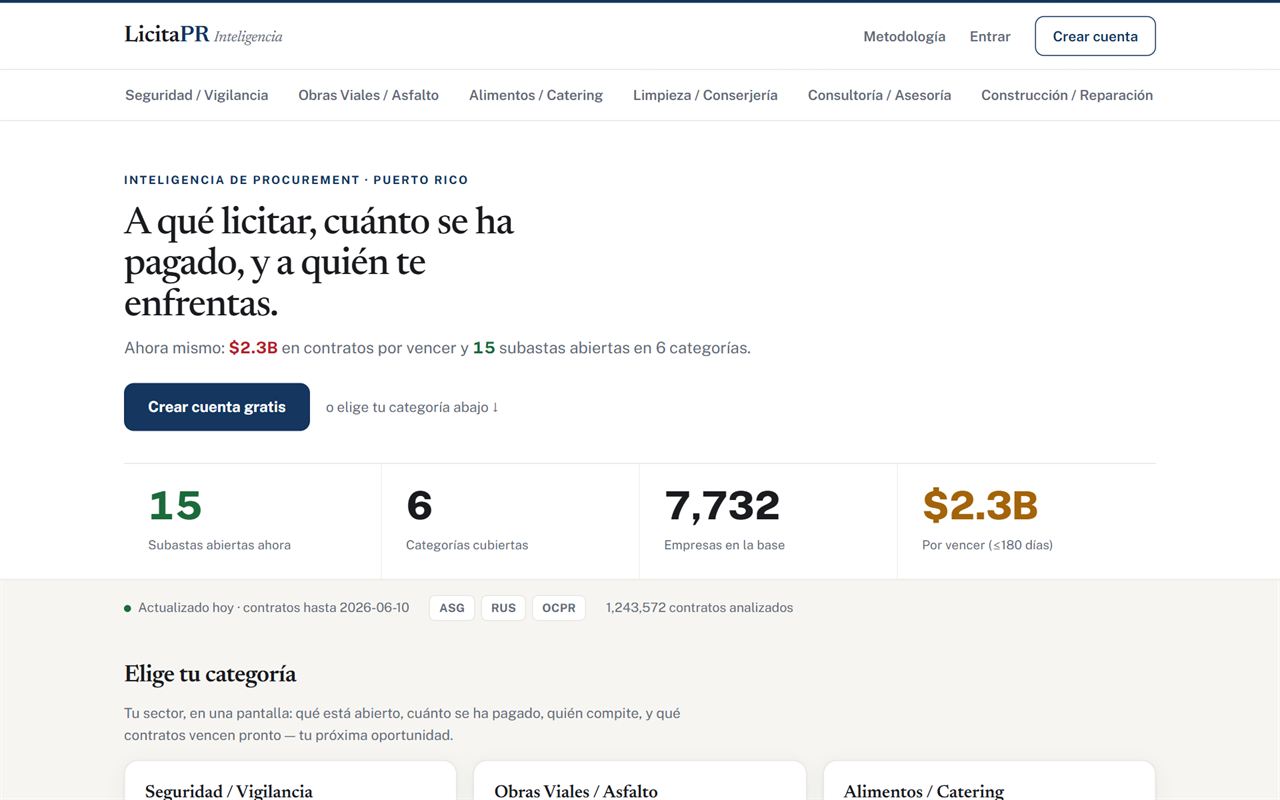
Six government systems that don’t talk to each other, unified into one procurement-intelligence product that looks ahead instead of back.
Vendor-facing intelligence built on Puerto Rico public data. It answers the questions a bidder actually has. What can I bid on? What does this work pay? Which contracts expire next (the re-bid), and who holds them?
Problem
Public procurement data in Puerto Rico exists, but it’s spread across six separate government systems that don’t interoperate. What’s there only looks backward. Watchdog and transparency tools tell you what already happened. A vendor deciding where to spend bid-prep effort needs the opposite. They need to know what’s coming up for re-bid, what the work pays, and who they’d be bidding against.
The expiring-contract radar is the wedge. It’s re-bid intelligence: which contracts come up next and who holds them. That’s the part people will pay for.
Build
The product
A multi-category, searchable site spanning six procurement categories. Per category, vendors get a clear free-vs-paid line:
- Open RFPs: free
- Award pricing: paid
- ★ Expiring-contract radar: paid (the wedge)
- Competitor leaderboard: paid
On top of that sit firm and agency drill-down dossiers and server-rendered charts. A server-side paywall enforces the free/paid boundary with no view-source leak. The visual identity is institutional on purpose. Public Sans with a Newsreader serif, tabular figures, semantic color. It reads like an intelligence product, not a dark-terminal cliché.
Data engineering (acquisition)
Six Puerto Rico government systems scraped, structured, cross-linked, and quality-monitored:
- ~1.24M contracts ingested, about 90% of the known universe.
- 50K+ legislative measures toward the full record since 1985, with GPU-OCR’d bill text.
- 440K+ campaign-finance donations across 125K+ donors. The finding that 98.8% of donation dollars come from individuals drove the schema design.
- ~1,700 RFPs, plus a corporate-registry crawler feeding entity resolution.
The crawlers hold up against messy public sources. They’re resumable and idempotent, and a supervisor auto-restarts jobs.
Entity resolution
A corporate-registry crawler feeds Splink + deterministic entity resolution, collapsing 422K vendor records to ~345K resolved entities with confidence scores attached. The framing stays strict. The system maps public records and flags patterns for review. It never accuses. A tempting fraud thesis got tested hard and falsified 0/15, so I killed it instead of shipping it.
Engineering quality and honest data
- A standalone 51-check data-quality monitor and integrity-checked nightly snapshots.
- A 62/62 QA harness on the product surface.
- Honest-data discipline. A completeness audit caught ~80K silently-missing measures. I re-crawled them instead of serving partial data.
Architecture and ops
A clean security boundary keeps the internal warehouse separate from anything public:
- Internal 1.29 GB warehouse → nightly ETL → a small, indexed
product.sqlite. - A read-only public Flask app serves only the slimmed product database, behind a cloudflared tunnel.
- Result: instant indexed lookups for users, with the working data never exposed.
Numbers
- ~1.24M government contracts ingested (~90% of the universe)
- 422K → ~345K vendors resolved to entities (Splink + deterministic)
- 440K+ campaign-finance donations across 125K+ donors
- 50K+ legislative measures toward the full record since 1985
- 6-category live procurement-intelligence product
- 62/62 QA harness · 51-check data-quality monitor
- ~80K silently-missing measures caught by a completeness audit and re-crawled
Stack
Python · Flask · SQLite (WAL) · Splink · Patchright · httpx/selectolax · EasyOCR (GPU) · cloudflared
Stack
Have data? Let’s make it think.
Open to Data & AI technical-lead and leadership roles, and to Vizlogic consulting engagements.